
PFOS Fire-Extinguishing Agents Banned on New Ships From 2026
From 1 January 2026, PFOS-containing fire extinguishers were banned on new ships; existing ships must comply at their first survey after that date.
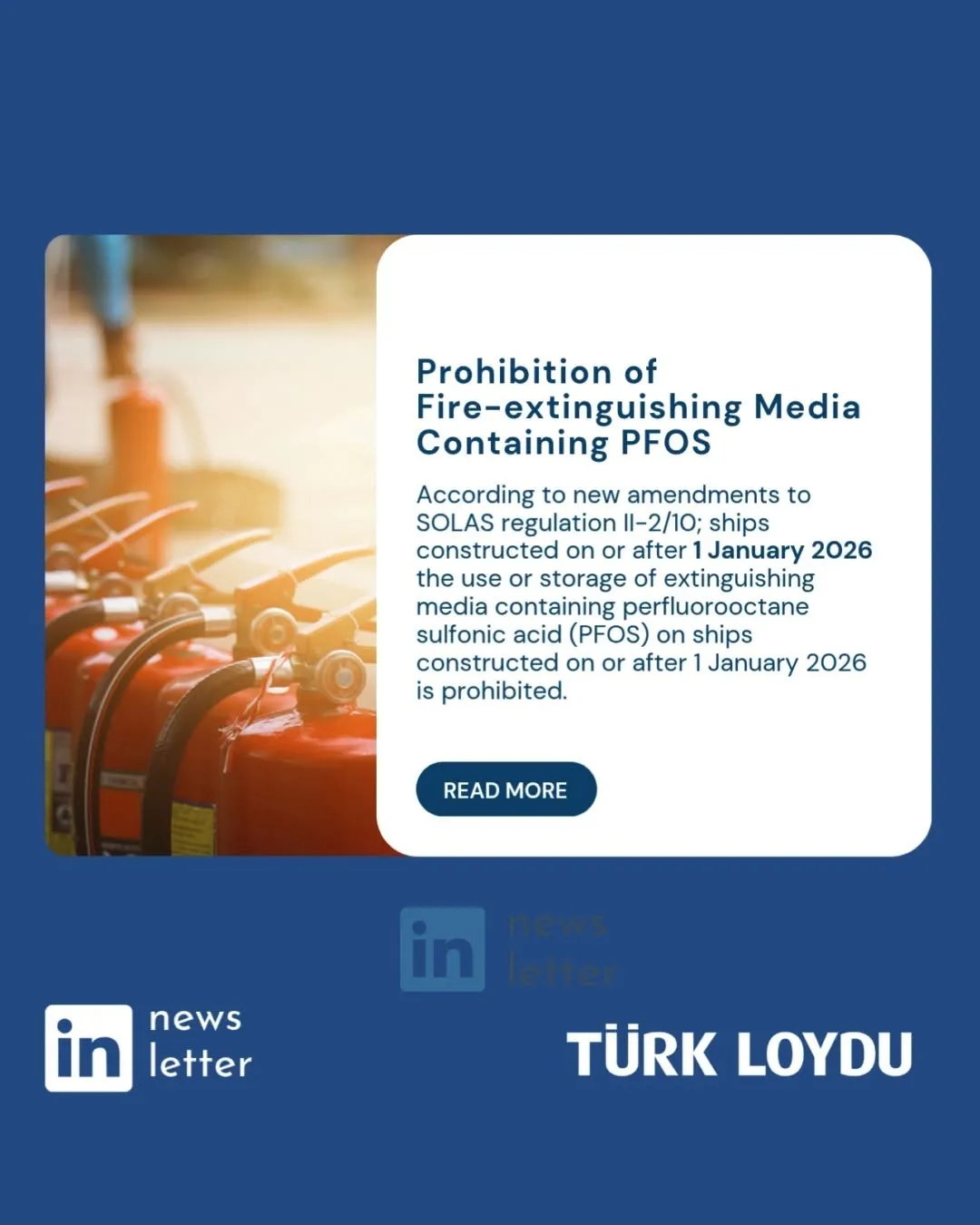
An important environmental regulation for the shipping sector entered into force on 1 January 2026: the use and storage of fire-extinguishing agents containing PFOS on newly built ships was banned. The regulation had been announced to the sector in a bulletin published by Türk Loydu (a classification society based in Türkiye) in October 2025.
What is PFOS, and why is it being banned?
PFOS (perfluorooctane sulfonate) is a synthetic chemical that had long been widely used in firefighting foams. Because it persists in the environment without breaking down for a long time, it is classified as a "persistent pollutant"; when it enters the sea, it accumulates in aquatic ecosystems, posing a risk to the environment and human health. The ban is therefore aimed at protecting environmental health and preventing marine pollution.
What are shipowners doing?
With the regulation, a shift to alternative fire-extinguishing products is being encouraged in order to maintain ship safety and firefighting capacity. In new construction projects, fire-extinguishing systems must now be designed with PFOS-free products.
The steps shipowners and operators need to take, and the details of implementation, can be followed through the bulletin published by Türk Loydu.
Basis of the ban: the SOLAS amendment
The regulation stems from Rule 10.11, added to chapter II-2 of the SOLAS Convention under IMO Maritime Safety Committee resolution MSC.532(107); in the same package, the 1994 and 2000 High-Speed Craft (HSC) codes were also updated under resolutions MSC.536(107) and MSC.537(107). The rule is not limited to new ships alone: ships whose construction begins on or after 1 January 2026 are equipped with PFOS-free systems on delivery, while existing ships must comply at their first survey after that date. The ban covers extinguishing agents containing PFOS at a concentration above 0.001% by weight (10 mg/kg) and applies to both fixed systems and portable equipment.
Classification societies play a key role in regulations of this kind: by verifying and certifying that new rules are correctly reflected in ship design and equipment, they support shipowners' compliance with international rules and ships' insurability. Changes to fire safety equipment are also a topic followed in hull and machinery insurance and in P&I (protection and indemnity) cover.
Source: Türk Loydu's bulletin announcement — https://www.instagram.com/p/DPldMYoFeuH/